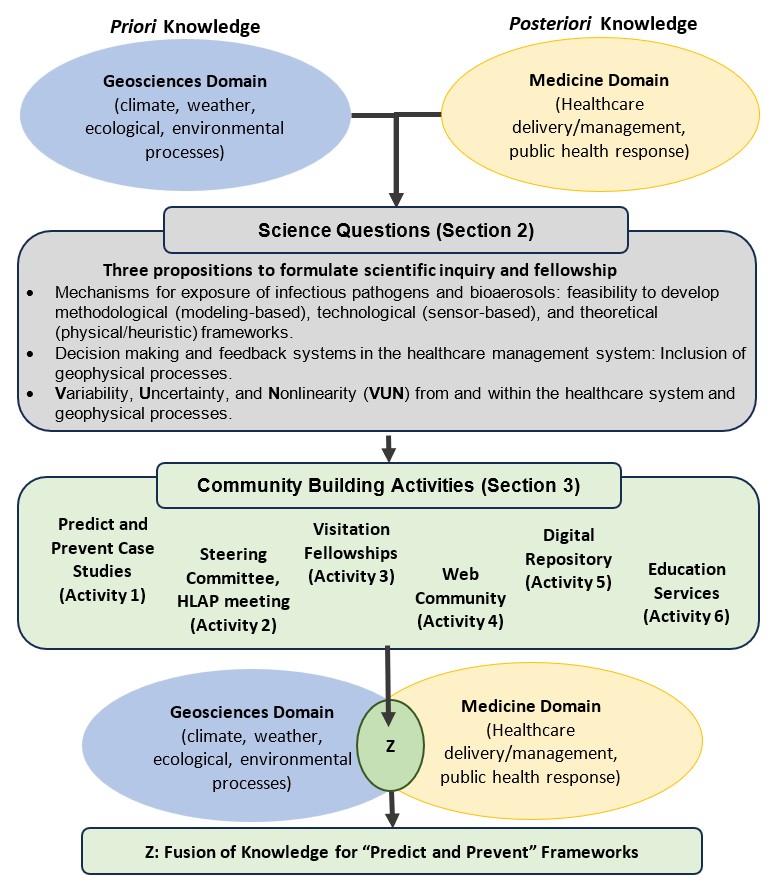
We argue that currently siloed pathways of information-generating knowledge within geosciences and medicine domains create an essential bottleneck for an effective translation of public health response to infectious pathogens and respiratory issues generated from bioaerosols. Since we cannot separate boundaries of where humans live and work, therefore climate, weather, and environmental processes must be aligned with pathogens and pathogenesis to form a coherent and cohesive knowledge for resilient healthy human communities.
The RCN is designed to develop a dynamic platform to maximize the utility and translation of the priori and the posteriori knowledge in such a way that it creates an environment and opportunities between the two societally relevant disciplines and professionals. This RCN provide opportunities to explore how new possibilities of knowledge emerge, what constraints limit the possibilities, and how discoveries can be accelerated within geosciences and medicine domains. In providing the conceptualization, we envision and anticipate theorizing frameworks for the prediction (when, where, and how) and prevention (what) of the prevalence of infectious pathogens and associated bioaerosols, which is achievable through careful synthesis of the priori and the posteriori knowledge.
This effort is organized around the following premise:
Translation of mutually exclusive possibilities derived from a careful synthesis of the priori (geosciences domain) and the posteriori (human health and medicine domain) knowledge is necessary to develop prediction and prevention frameworks of when, where, and how societally relevant infectious pathogens and associated bioaerosols pose a risk to human health.